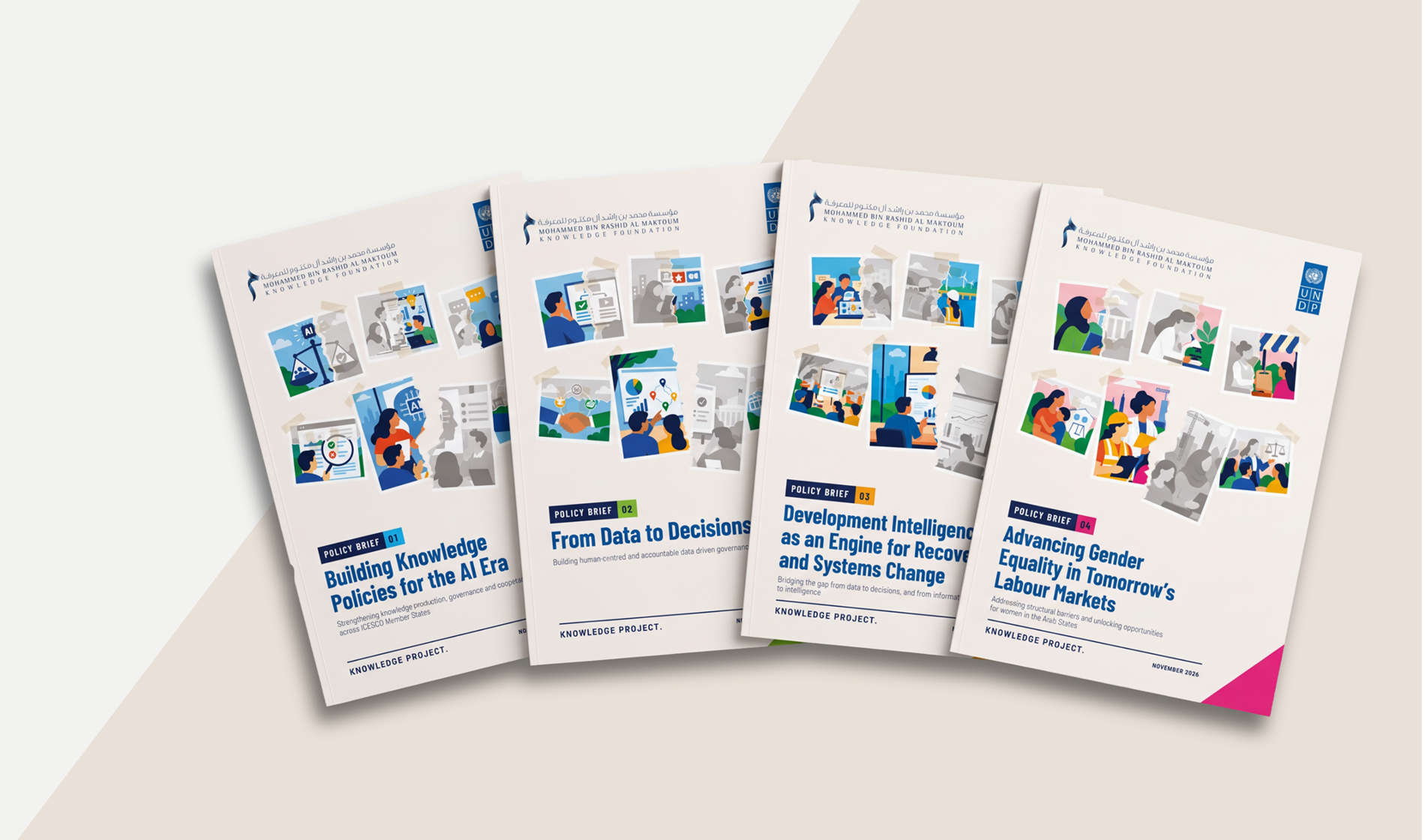
The Knowledge Project has released a series of four policy briefs addressing key development challenges. Each brief builds on a policy roundtable held during Knowledge Summit 2025 and brings together expert insights, the latest international evidence and practical recommendations for policymakers.
The first brief, Building Knowledge Policies for the AI Era, looks at how Member States of the Islamic World Educational, Scientific and Cultural Organization (ICESCO) can move from consuming knowledge to producing it. Most of these countries spend less than 0.5 percent of GDP on research and development, against a global benchmark of 2–4.5 percent. The brief sets out six priorities, from national knowledge governance and trustworthy AI to multilingual content, media literacy and regional cooperation.
The second brief, From Data to Decisions, explores how governments can turn growing data and AI capabilities into decisions that are more effective, accountable and human-centred. It notes that the Global Knowledge Index 2025 could compute an overall score for only 149 of the 195 countries it covers because of data gaps. It also notes that every dollar invested in data systems is estimated to return US$32. The brief was developed with the Business Practice and Policy Initiative at the American University of Beirut.
The third brief, Development Intelligence as an Engine for Recovery and Systems Change, introduces development intelligence: insights drawn from big data, foresight, lived experience and AI, packaged to inform strategic decisions in fast-changing and uncertain contexts. It explains how this intelligence is generated and used, shares real-world examples and recommends practical first steps for building the capability.
The fourth brief, Advancing Gender Equality in Tomorrow’s Labour Markets, examines the barriers facing women in the Arab States. Female labour force participation in the region is estimated at 19 percent, compared with 71.1 percent for men and a global female average of 40.2 percent. Drawing on UNDP research with the Economic Research Forum, the brief shows how women’s participation is changing in the digital, green and blue economies and proposes ways to close the gap.